
ALLPOWERS R2500 V2 + 160W Panel
7.5Very good · out of 10$719.04 -5% List price- Stated: 1,920 Wh · 160 W panel
- Portable power stations
Product images: Amazon listings
On paper, the ALLPOWERS R2500 V2 + 160W Panel gets the important things right: a 160 W panel in the box, a 1,920 Wh battery and UPS switch-over in 15 ms. It makes most sense for outage prep that doesn't wait for the grid; we rate it 7.5/10 from its listing.
| Brand | ALLPOWERS |
|---|---|
| Category | Portable power stations |
| Battery capacity | 1,920 Wh (stated in the Full listing title, not verified against manufacturer documentation) |
| Full wall charge | About 1 hour, per the listing |
| Charge cycles (stated) | 3,500 |
| UPS / EPS mode | Stated, 15 ms switch-over |
| Stated warranty | 5 years |
| ASIN | B098SM84SD |
Full listing title: ALLPOWERS R2500 V2 1920Wh Portable Power Station with 160W Solar Panel
Rated from the listing's specs, no buyer reviews yet
What it's made for: outage prep that doesn't wait for the grid.

The two solar generator kits closest to it on our rating, with a dated price.


Battery capacity stated in the listing for the station in the kit. Plan on roughly 1,632 Wh at the outlet after conversion losses (our 0.85 rule of thumb).
What it has going for it
160 W panel included. Station and panel arrive in one order, already matched by the seller. The panel rating is a sunny-day ceiling, so expect less on a hazy afternoon.
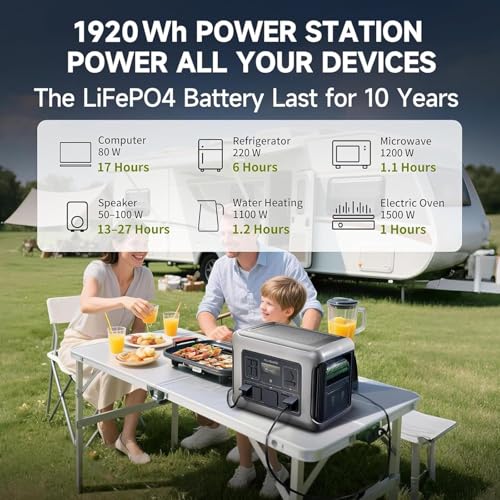
1,920 Wh battery. At a steady 100 W that is roughly 16.3 hours, after the usual conversion losses (our 0.85 rule of thumb). Enough to carry the fridge, the router and the lights through a long evening and well beyond, if your load list adds up.
UPS, 15 ms. Leave the router, the PC or a CPAP plugged in through it: when the grid drops, the station takes over on its own, in 15 ms per the listing. Before you trust it with a desktop computer, read the manual on switch-over time.
At home, it can sit between the wall and the router and take over on its own (15 ms, per the listing). 1,920 Wh is a reserve you can plan a long outage around.
Away from home, the 160 W panel in the box refills it during the day.
What the ALLPOWERS R2500 V2 + 160W Panel listing names:
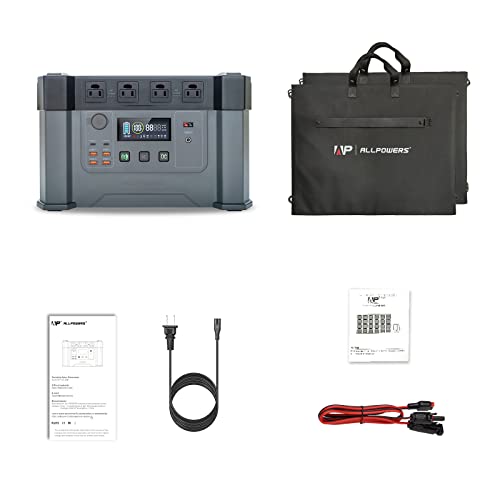
In the box, per the listing: AC charging cable, Detailed manual.
That is what the listing says comes with the ALLPOWERS R2500 V2 + 160W Panel. Check the box on delivery day, before the cardboard goes out with the recycling.
That is the maker's promise, not ours. Keep the order confirmation, and register the ALLPOWERS R2500 V2 + 160W Panel if the maker asks you to.
Check your own plugs and your load list against it before you order.
At the price on Nov 17, 2026, each stated watt-hour costs about $0.37. That puts it in the cheaper third of the 48 stations and kits we have a price for.
The button opens the exact listing (ASIN B098SM84SD), where today's price, stock and seller apply.
Need longer runtime? The EcoFlow DELTA Pro 3 + 400W Panel (8.1/10) states 4,096 Wh, about twice as much.
Our take
What we'd buy the ALLPOWERS R2500 V2 + 160W Panel for is a 160 W panel in the box, with a 1,920 Wh battery as a bonus. No buyer reviews yet, so this ALLPOWERS solar generator kit has to win you over on paper. The catch with the ALLPOWERS: no word on the continuous output or the weight. We'd pick it if you want solar charging without matching the parts yourself; otherwise, put it next to the Anker SOLIX C300 + 60W Panel first.
Charge it to full from the wall, then plug in a lamp and one thing you really rely on, so you know how it behaves before you need it.
If the router or the fridge already runs through it, the switch-over happens on its own (15 ms, per the listing). Watch the percentage for the first hour; it tells you more about your real runtime than any chart. Our rule of thumb says about 16.3 hours at 100 W.
Between outages it refills from the wall. During a long one, the 160 W panel in the box tops it up on sunny days; prop it at the sun and move it as the shade moves.
Store it at the charge level the manual recommends and top it up every few months. LiFePO4 cells are relaxed about this, but every battery slowly self-discharges. Our storage guide has the routine.
Before you order the ALLPOWERS R2500 V2 + 160W Panel: check what is in the bundle, because it pairs the station with a 160 W panel and 1,920 Wh of storage, so the cable in the box and the station's solar input limit decide whether it all works together.
1,920 Wh, per the listing. Write down what has to run at the same time and for how long, then let our runtime calculator do the sums.
Anything with a compressor or a motor pulls a short spike when it starts; our refrigerator guide shows how to check a fridge or a freezer.
15 ms, per the listing. Fine for most routers and lamps; for a desktop PC or a medical device, read our EPS vs UPS guide and the manual first.
A battery station gives off no exhaust, so it can sit indoors within the temperature range its manual gives. Our storage guide has a simple routine for the months between outages.
How the ALLPOWERS R2500 V2 + 160W Panel stacks up against the closest alternative, the Anker SOLIX C300 + 60W Panel.
| Criterion | ALLPOWERS R2500 V2 + 160W Panel | Anker SOLIX C300 + 60W Panel |
|---|---|---|
| Our rating | 7.5/10 | 7.6/10 |
| Battery capacity | 1,920 Wh | 288 Wh |
| Continuous output | Not stated | 300 W |
| Panel in the box | 160 W | 60 W |
| UPS / EPS | 15 ms | Not stated |
Pick the Anker SOLIX C300 + 60W Panel if you want our higher-rated option (7.6/10), with more continuous output (300 W); stay with the ALLPOWERS R2500 V2 + 160W Panel for a bigger battery (1,920 Wh) and a bigger panel (160 W).
We rate it 7.5/10 (very good). The rating comes from its documented listing alone, as no customer-review record is captured yet.
Its listing title states 1,920 Wh of battery capacity. Watt-hours decide how long it lasts; continuous watts decide what can run at the same time. These are the seller's figures, so check them against the manual.
Roughly 16.3 hours: 1,920 Wh × 0.85 for conversion losses ÷ 100 W. Idle draw, cold weather and battery age move the real figure, and our power runtime calculator works with your own numbers.
Its listing states a 160 W panel in the box, 1,920 Wh of stored energy, a 15 ms UPS switch-over, a full wall charge in about 1 h, LiFePO4 cells rated for 3,500 cycles and a 5-year warranty. These are the seller's figures; how long it really lasts on your fridge and how loud the fan gets under load can't be read from a listing.
Your load list: 1,920 Wh, per the listing. Write down what has to run at the same time and for how long, then let our runtime calculator do the sums. The start-up spike: anything with a compressor or a motor pulls a short spike when it starts; our refrigerator guide shows how to check a fridge or a freezer. The switch-over: 15 ms, per the listing. Fine for most routers and lamps; for a desktop PC or a medical device, read our EPS vs UPS guide and the manual first. Where it lives: a battery station gives off no exhaust, so it can sit indoors within the temperature range its manual gives. Our storage guide has a simple routine for the months between outages.
We link to the exact listing on Amazon, where today's price, stock and seller apply. It is an affiliate link, and it has no effect on the rating.