
Jackery SolarSaga 100 Prime
7.3Good · out of 10See current price ↗- Stated: 100 W panel
- Solar panels
Product images: Amazon listings
The Jackery SolarSaga 100 Prime packs a 100 W rating, 25 % cell efficiency and an IP68 rating into one solar panel. Add a bifacial design and it makes a good match for a long outage with sun in the forecast.
| Brand | Jackery |
|---|---|
| Category | Solar panels |
| Stated warranty | 5 years |
| Panel rating | 100 W |
| Cell efficiency | Up to 25 % |
| Weather rating | IP68 |
| Connector | Anderson |
| Bifacial | Stated in the listing |
| ASIN | B0D3DPN424 |
Full listing title: Jackery SolarSaga 100 Prime Bifacial DIY Solar Panel,100W
Rated from the listing's specs, no buyer reviews yet
What it's made for: a long outage with sun in the forecast.

The two solar panels closest to it on our rating, with a dated price.


The rated output in ideal sun, per the listing, from cells stated at up to 25 % efficiency. On a real day expect less: heat, haze and the angle all take their share.
What it has going for it
100 W panel. 100 W is the rating in ideal sun. Good for a small station, phones and lights; a big station wants several.
25 % efficiency. More watts from the same surface, so the panel can be smaller and lighter for its rating.
IP68. IP68 means dust-tight and rated against immersion. A passing shower won't end the day; fold it away dry anyway.
At the campsite, IP68, per the listing, makes the weather less of a gamble. The built-in stands set the angle without propping it against the car.
In the backyard, the bifacial back picks up extra light off a pale patio, sand or snow. 100 W keeps a small station topped up between outages.
The seller states, word for word, in the Jackery SolarSaga 100 Prime listing:
Boasting a remarkable 25% conversion efficiency, the portable solar charger delivers stable output, even on cloudy days and in dim-lighting.
Delivering 80% output even after 10 years use, The SolarSaga 100 Prime DIY Solar Panel ensures long-lasting performance and durability.
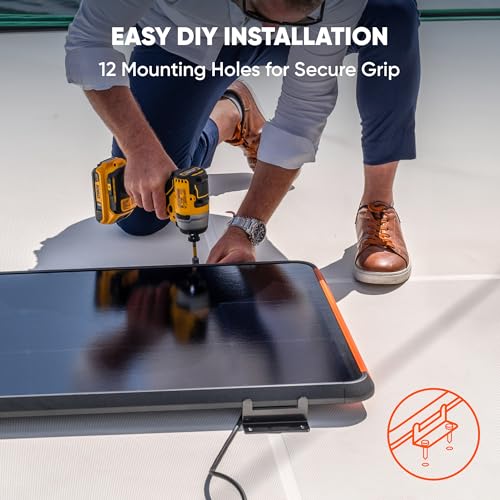
Featuring 12 mounting holes the solar charger, further provides safe installation and stable power generation.
The SolarSaga 100 Prime adopts no-lead manufacturing and 100% eco-friendly packaging, creating a significantly positive impact on the environment.
Note: For older Jackery models like the E1000, E550, E500 E300, E240 & E160, a DC8020 to DC7909 adapter is required.
Their words and their figures.

What the Jackery SolarSaga 100 Prime listing names:
That is the maker's promise, not ours. Keep the order confirmation, and register the Jackery SolarSaga 100 Prime if the maker asks you to.
Hold the plug and the voltage against your station's solar input before you order.
We have no recent price on file for this listing, so we don't print an old one.
The button opens the exact listing (ASIN B0D3DPN424), where today's price, stock and seller apply.

Feeding a big station? The Jackery SolarSaga 200W (7.6/10) is rated 200 W.
Our take
We like the Jackery SolarSaga 100 Prime for a 100 W rating and 25 % cell efficiency. No buyer reviews yet, so the Jackery SolarSaga 100 Prime has to win you over on paper. The catch with the Jackery SolarSaga 100 Prime: the plug and the voltage have to match your station, so check both first. We'd pick it if you need a light panel for a small station; otherwise, put it next to the Anker SOLIX PS100 Solar Panel first.
Unfold it, flip out the stands and face it to the sun, plug the Anderson lead into the station and check the input reading. If you are around, turn it with the sun every couple of hours.
Fold it dry (it is IP68, but hinges and plugs last longer dry), and store it flat.
Before you add the Jackery SolarSaga 100 Prime to your cart: check the connector, because it connects through Anderson, and your station's solar input has to accept that at 100 W.
Take a photo of your station's solar input and its label, and compare the plug and the voltage window with the listing. Our solar panel compatibility guide lists what to compare.
100 W of panel only help up to the input ceiling of your station. Look that figure up before you buy a second panel.
Full sun, facing south in the US, angled to the sun and clear of shade. Even a branch across one corner cuts the output noticeably.
How the Jackery SolarSaga 100 Prime stacks up against the closest alternative, the Anker SOLIX PS100 Solar Panel.
| Criterion | Jackery SolarSaga 100 Prime | Anker SOLIX PS100 Solar Panel |
|---|---|---|
| Our rating | 7.3/10 | 7.3/10 |
| Efficiency | 25 % | Not stated |
| Weight | Not stated | 7 lb |
| Connector | Anderson | Not stated |
Both score 7.3/10. The Anker SOLIX PS100 Solar Panel adds less weight (7 lb), while the Jackery SolarSaga 100 Prime brings higher efficiency (25 %).
We rate it 7.3/10 (good). The rating comes from its documented listing alone, as no customer-review record is captured yet.
Only if your power station manual says so. Check the connector, the input voltage and current limits, the list of supported models and any adapter the manual asks for; the same brand name on both boxes does not prove a fit.
Its listing states 100 W of panel power, 25 % cell efficiency, an IP68 rating and a bifacial design. These are the seller's figures; what it really delivers on your roof or at your campsite depends on sun, angle and heat.
Match the plug and the voltage: take a photo of your station's solar input and its label, and compare the plug and the voltage window with the listing. Our solar panel compatibility guide lists what to compare. Your station's solar limit: 100 W of panel only help up to the input ceiling of your station. Look that figure up before you buy a second panel. Where it will sit: full sun, facing south in the US, angled to the sun and clear of shade. Even a branch across one corner cuts the output noticeably.
We link to the exact listing on Amazon, where today's price, stock and seller apply. It is an affiliate link, and it has no effect on the rating.